
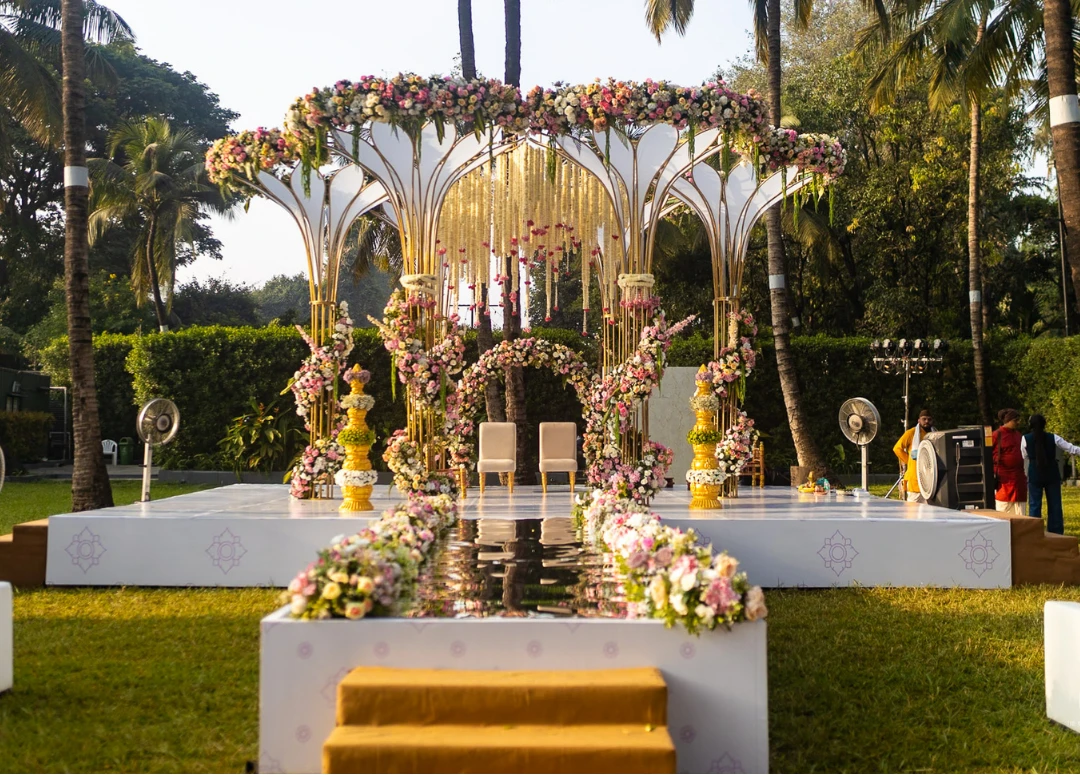
A beach wedding in Goa is decided by four things: the tide and sunset time on your date, how guests will walk on sand, what sound and set-up the venue allows on the beach, and a covered rain plan. Fix those before choosing decor. Gātha plans Goa beach weddings from Pune through video walkthroughs and an on-ground team.
Beach wedding in Goa: what the sand changes
A beach wedding in Goa moves the ceremony, and sometimes the whole evening, onto sand. That changes the order in which you decide things. On a lawn you pick the date, then the design. On a beach the tide, the sunset time and the wind come first, and the design is built around what they leave you.
Most families split the day. The ceremony or a short blessing happens at the water's edge, and dinner, dancing and the sangeet move to a lawn or covered area on the same property. That split is easier on guests and on the team, because sand is a hard surface for a sit-down meal, a dance floor and a kitchen. The sections below take the beach part on its own. For the wider event, see the page on a destination wedding in Goa.
Tide and light: fix the hour before the date
Tides run on a timetable that is published for the coast, so ask the venue for the tide times on each date you are considering. At high tide the dry, usable strip of sand can shrink to very little. At low tide it widens, but the sea is further away and the sand near the water is wet and soft. Neither is wrong. You only need to know which one you will have when the guests sit down.
Goa's beaches face west, towards the Arabian Sea, so a late-afternoon ceremony faces the sunset. That is the setting most people picture. It brings two practical questions:
- Which way do the guests face? Seating that looks straight into the low sun makes people squint through the whole ceremony. Angle the rows, or seat guests side-on to the water.
- How long is the ritual? A ceremony with many rites can run past the soft-light window. Start earlier than sunset, not at it.
After sunset the beach goes dark quickly, and everything you need for light and sound has to be installed in advance. Ask your photographer and videographer to walk the spot at the planned hour, since they will tell you where the light drops first.
Planning a wedding of Rs 30 lakh or more? Share the shape of your celebration and the team will read it personally.
Begin your application →Sand, heels and the guest walk
Sand changes how people move. Dry sand slows everyone. Damp sand is firmer but cold and wet underfoot. Stiletto heels sink, and a guest in a sari or lehenga carrying a pleated hem across a long stretch of loose sand is not enjoying the occasion.
Plan the walk as carefully as the seating:
- Find where vehicles drop guests and measure the route to the first row. Ask for a laid walkway of matting or boards over the loose stretch.
- Offer a basket of flat sandals or a barefoot option at the entrance, and say so on the invitation or the guest information card.
- Check access for elders and anyone who uses a wheelchair or a stick. Boards over sand can work, but they need to be level and wide enough.
- Seat people on chairs with wide feet or base plates, because ordinary chair legs sink and tilt.
- Keep children away from the waterline during the ceremony by giving someone that job by name.
The stage, the mandap or the ceremony frame also needs a firm base. Staging platforms on sand are levelled and braced, and that work takes time on the day. Build it into the schedule.
Sound, permissions and neighbours: questions, not rules
This page does not state any rule about music, structures or beach use in Goa. Rules differ by property and by stretch of coast, and they change. The venue's written answer is the authority, so ask before you fall in love with a spot.
| Ask | Why it matters | Get in writing |
|---|---|---|
| Is the stretch of beach private to the property, or open to the public? | It decides whether other people can walk through your ceremony. | A description of the area you may use |
| Is amplified music allowed on the sand, and until what hour? | A sangeet that works on a lawn may not be allowed at the water. | The cut-off time and where it applies |
| Does a beach set-up need any permission, and who applies for it? | Responsibility should sit with one named party, with a date by which it is secured. | Who obtains it and by when |
| May structures, fire or lights be set up on the beach? | Stage frames, havan fires and candles each have their own answer. | A yes or no for each item |
| What happens to the beach set-up if the permission is refused late? | You want the fallback decided before it is needed. | The alternative space |
Speaking to the venue is the family's first step, and a planner can carry the questions. The list of questions for any property is in the guide to wedding venues in Goa.
Decor that survives wind and salt air
Wind is the main enemy of beach decor, and the sea breeze is steady rather than occasional. Light drapes act as sails, tall floral arrangements tip, and anything unweighted drifts. Design for a breeze from the start.
- Keep structures low or well anchored. Frames need weighted bases or buried anchors, which you should clear with the venue before the design is final.
- Choose fabrics with weight, or use fewer, shorter drops. Loose chiffon looks beautiful in a studio and misbehaves on a beach.
- Put candles inside glass. Open flames do not last in a sea breeze.
- Place fresh flowers last, as late as the schedule allows. Sun, salt and wind tire them faster than an indoor hall would.
- Fit wind covers on every mic, and test sound with guests' chairs in place.
- Bring lighting that works without relying on a distant mains point, with generator cover for the ceremony.
Natural materials, such as driftwood tones, shells, rope and low floral beds, suit the setting and need less structure than a tall build. The idea gallery on beach wedding decor goes further into looks and materials.
The rain plan: decide it before you book
Goa's monsoon runs from about June to September. Outside those months rain is less likely, but a plan should still exist, because a ceremony on sand with no cover has no good improvised answer.
A real rain plan answers four things:
- Where do the guests go, and is that space big enough to seat the ceremony as well as the dinner?
- What is the decision time, and who makes the call? Agree it with the venue and the family in advance, so no one debates it on the day.
- Does the decor move? Build two layouts, one for the beach and one for the covered area, and brief the on-ground team on both.
- Does the music, lighting and power plan work in the second space?
If a venue cannot show you the covered alternative, treat the beach ceremony as a risk and weigh it accordingly.
Beach or resort lawn
Both are good choices. The difference is what each asks of the family.
| Factor | Beach | Resort lawn |
|---|---|---|
| Backdrop | The sea does most of the decor work | You build the setting with stage, floral and lighting |
| Timing | Set by tide and sunset | Flexible, within the venue's rules |
| Guest comfort | Sand, wind and glare need managing | Firm ground, shade and seating are simpler |
| Sound | Often more constrained; confirm with the venue | Subject to the property's own cut-off |
| Rain cover | Needs a separate covered space | Tents or an indoor hall nearby |
| Set-up time | Short windows, heavy carrying | Longer, with vehicle access |
Many families choose the beach for the ceremony alone and a lawn for everything else. If the property you like offers both, ask how long the changeover takes. The guide to wedding resorts in Goa covers the resort side of that choice.
How Gātha plans a beach wedding in Goa
Gātha is a boutique wedding atelier in Pune. A Goa beach wedding is planned from here through venue scouting and virtual walkthroughs, digital drawings, video reviews and an on-ground team at the destination. Gātha is not a venue-booking service and does not book a beach on its own. Venue selection is one part of planning the whole wedding, and the family makes the final choice. Read the full scope on the page for a wedding planner in Goa.
The planning fee is tiered by the overall investment in the wedding: Rs 2,00,000 onwards for weddings of Rs 30 to 60 lakh, Rs 3,00,000 onwards for Rs 60 lakh to 1 crore, and Rs 5,00,000 onwards for Rs 1 crore and above. It covers design, planning and direction. Venue, decor and vendor costs sit inside the family's own spend and are shown transparently. Weddings with a total below Rs 30 lakh are outside what Gātha takes on.
Gātha takes a limited number of weddings each year, and every enquiry is read personally. Share your dates, guest count and ceremony setting on the application page. The team replies within two working days.
Questions people ask
Keep reading
Updated 2026-11-05